
From Innuneeli’s Thatched Hut to the Skies of Women’s Football: The Real Story of a People's Movement
In the quiet eastern stretches of Chalakudy, beneath the shade of coconut trees and the toil of everyday life, lived a woman named Innuneeli — illiterate, impoverished, and forgotten by history, yet deeply remembered by her people. She worked as a headload worker in the Chalakudy market during the 20th century, collecting bananas from nearby homes and carrying them to market on foot. She lived alone in a simple thatched hut, her only daughter having passed away young. She worked as long as her body permitted. In her final days, it was her kind-hearted neighbours, Mr. Velayudhan and his wife, Ms. Kurumbakutty, who looked after her with dignity and care.
When Innuneeli passed away in 1990, her body was laid to rest beside her small hut — a simple woman, buried quietly in the land she called home. For nearly a year, the hut remained vacant — a silent space soon to become the heart of a community story.
The land, however, was unassessed and undocumented — Innuneeli had never possessed a legal title or deed. Over time, the hut and the plot fell into neglect, becoming almost useless and even a center of social nuisance. At this crucial moment, Mr. Unnikrishnan, the younger son of the neighboring family who had cared for her, stepped forward. Recognizing the importance of preserving the space for community welfare, he approached a group of local youngsters and encouraged them to take over the hut and transform it into something meaningful for the public.
In 1991, the youth accepted the challenge and, under the leadership of Mr. Suresh Kumar and Mr. K. M. Priyan, formed a committee. In their first meeting, they resolved to transform the humble hut into a library — not only because Chalakudy lacked accessible reading spaces outside the town, but because they believed it could serve as a much-needed hub for learning in the area.
The second major decision was to name the library. During the discussion, one member proposed: since Innuneeli had lived, died, and been buried on that land, the library should bear her name as a quiet tribute to her presence. Thus, the Innuneeli Smaraka Vayanasala (Innuneeli Memorial Library) was born — not as a monument to her story, but as a purposeful use of her resting place, transformed into a gift to the community.
This library may be the only one in India — or perhaps the world — named after an illiterate woman who worked as a daily-wage labourer in a local market. That alone makes it a rare and powerful symbol of how ordinary lives, too, deserve remembrance and legacy.
With books collected from local homes and small donations raised through community effort, the library came to life. It was formally opened on 15th August 1991 with a flag-hoisting ceremony and Independence Day celebrations. The inaugural event also featured a drama performance and a mimicry show — the mimicry artist being none other than Kalabhavan Mani, who would later rise to fame as a celebrated singer, actor, and stage performer.
The library was soon registered in 1991 as a charitable society under the Charitable Societies Act of 1955, giving it a formal identity and organisational strength.
For a time, the library flourished — a beacon of knowledge for the local youth and families. But as the years passed, the young founders moved away for jobs and responsibilities, and the library gradually became inactive.
Towards the end of the 1990s, new energy returned. The community stepped in once again, and the library was revived. The old thatched roof was replaced with tiles. Small cultural events began to bring people together. A fresh chapter was unfolding.
In 2006, the library began offering free PSC coaching classes, opening new pathways for the local youth. That PSC initiative remains active to this day, with young members not only sustaining the training program but also serving as its resource persons, occasionally leading sessions in nearby libraries before securing government jobs themselves. Since 2006, over 102 youngsters have entered various departments and are now serving in government roles. Meanwhile, the library’s book collection and membership steadily expanded, transforming it into a quiet yet enduring force in the lives of the community.
In 2008, the library became officially affiliated with the Kerala State Library Council and was graded as an ‘F’ Grade Library. This recognition inspired the team to expand their efforts further. From that point on, the library began regularly organising festival celebrations, literary programmes, and strengthening its PSC coaching initiatives — creating a vibrant space for learning and cultural expression.
Then, in 2016, the members decided to celebrate the Silver Jubilee of the library — marking 25 years since its founding in 1991. This was not just a milestone, but a month-long celebration that became a moment of rediscovery and reinvigoration for the entire community. Branded as Paithrukam 2016, it marked a true turning point. Over the month, the library hosted a remarkable lineup of events — seminars, film festivals, football tournaments, a book fair, an exhibition of traditional commodities, organic farming demonstrations, youth, women, children, and senior citizens’ conferences, a folk concert, a grand Silver Jubilee rally, a cultural conference, an art festival, and even a mega Thiruvathira performance. Public participation in these events was remarkable, with people from all walks of life coming together to be part of the celebrations. These popular programs and the movement inspired the emergence of like-minded communities and youth initiatives in nearby areas. With its sheer scale and diversity of activities, Paithrukam transformed the library from a modest reading space into a vibrant, multi-dimensional cultural hub.
By the 25th anniversary, the library had grown to about 200 members and a collection of 2,300 books, although the library’s status remained at its ‘F’ grade under the Kerala State Library Council. The silver jubilee celebration acted as a catalyst for the library’s future. After the event, the library became more active than ever. Today, it proudly stands as the only ‘A’ grade library in the Chalakudy municipal area, with a collection of over 10,000 books and a membership of over 1,100 people.
After 2016, the library significantly broadened its range of activities. The library created dedicated forums for children, youth, women, and senior citizens, each of which began organising its programmes. To promote organic farming and food security, the library started an Organic Farming Club and launched farming as a community activity. With strong public support, the library was reconstructed, replacing the old building with a 115-square-foot structure that can accommodate 60 people at a time, offering more bookshelves and expanded reading space in its present form.
In 2017, the library became affiliated with the Kerala State Youth Welfare Board and the Nehru Yuva Kendra. In 2018, it received national recognition by being selected as the Best Youth Club in Thrissur District under the Youth Engagement Scheme of the Central Government’s Nehru Yuva Kendra.
In 2019, the library was honoured with the Best Youth Club in Thrissur District Award by the Kerala State Youth Welfare Board. That same year, the library initiated organic rice cultivation in its community farming project. During the COVID-19 pandemic, when machinery was unavailable, library members harvested the rice, cultivated in 5 acres manually and distributed it among fellow members — a remarkable act of solidarity, compassion, and resilience. For this, the library was recognised with the State Award for Best Library Practising Organic Farming.
From this foundation — a hut once on the edge of being lost — emerged a new dream.
Inspired by the same spirit of collective action and empowerment, the ISV Football Academy was bor
The Birth of ISV Football Academy
The spark that ignited ISV Football Academy came during the 2018 FIFA World Cup in Russia, when the library organized a vibrant month-long football-themed cultural festival called Ginkha 2K18. As part of the celebrations, a Kottaka (vintage-style movie theatre) was set up near the library to screen World Cup matches, attracting football lovers from across the area. Alongside the screenings, a variety of football-related events were held, including a football quiz, a football film festival, a football history exhibition, and seminars on the sport. One of the most attractive highlights was a marathon football match and a landmark gender equality football game held in Chalakudy town, where men, women, and transgender people played together to promote the message of gender equality and women’s empowerment. At that time, there were no female football players in the district, so the organisers arranged for women footballers from Kozhikode, 200 km away, to participate. The match was a huge success, and the female players impressed the crowd with their performance. Inspired by this, the girls from the library decided to take up football themselves. They formed a small team of seven and began playing regularly on a small ground near the library. Recognising their enthusiasm and passion, the library committee decided to support them by providing footballs, basic equipment, and minimal training from veteran players. While the girls improved, the lack of proper infrastructure and professional coaching hindered their growth. The library and parents searched for a girls’ football academy in Kerala, but found very few, most of them too far for regular training. So, the girls continued with their limited facilities, even playing exhibition matches during men’s tournaments in the area, showing remarkable dedication.
Realising the need for a more structured approach, the library committee decided to establish its own football academy for girls. Just as preparations began, the COVID-19 lockdown was announced. During this period, the project proposal was drafted and presented to the committee, which initially planned to lease land near the library to set up a ground. To raise the initial investment, members pooled resources through a chitty, collecting ₹83,000. However, despite searching, no landowners were willing to lease land for a football ground. The library then decided to collaborate with schools and presented the proposal to several institutions, facing multiple rejections before finally receiving approval from SNVHSS Aloor, located 7 km from the library.
On 2nd October 2021, the academy was officially inaugurated by former Indian national player Ms. C. V. Seena. Funds were initially sourced through monthly contributions from library members and like-minded well-wishers, with crowdfunding serving as the primary financial backbone in the early phase. Operating under the library as a public initiative, the academy began with 65 girls in its first batch, though some eventually dropped out. Training was led by two licensed coaches, and within just a year, the team began competing in local tournaments.
In 2022, they won the Subroto Cup at the district level, advanced to the state level, and reached the semi-finals. That same year, four players were selected to represent the district at the state level. During the first year, the academy functioned on limited funds, but as performance and results improved, the need for greater investment in training and facilities became clear. The library worked tirelessly to raise money through prize coupon sales, sponsorship requests, scrap collection drives, organizing tournaments, and other activities.
Despite financial challenges, the academy never compromised on regular training. The coaching team worked with unwavering dedication, delivering a minimum of 260 training days each year — a standard matched by only a handful of academies in Kerala. However, the lack of funds limited the introduction of advanced facilities such as extended playing hours, regular friendly matches, specialised strength and conditioning programs, physiotherapy and adequate nutritional support — all crucial for the players’ development. Even so, the team’s performance continued to improve steadily.
By 2025, 62 players from the academy had participated in state-level tournaments representing different districts, while 14 had represented the state at the national level in different age categories. The team also clinched district championships in the under-14, under-17, and under-19 categories in the previous year. The Under-15 team became zonal champions in the Reliance Foundation Football Tournament, while the Under-17 team finished as runners-up at the state level.
Remarkably, the academy — which began with girls who had only passion for football and no prior playing experience — is now competing on par with government sports schools, whose players are selected through state-level trials and receive full funding for training, nutrition, and accommodation. This journey stands as a testament to the hard work, determination, and commitment of both the players and the coaching team.In its third year, the academy entered the Kerala Women’s League by collaborating with City Club Chalakudy, an affiliate of the Kerala Football Association. The team finished in 4th place and earned the Fair Play Award. Gaining recognition across Kerala for girls’ football, the academy rebranded itself as ISV Kerala to reflect its ambition of representing the state on a global stage. With the long-term goal of becoming the best girls’ football academy in India and winning the Indian Women’s League, ISV Kerala continues to grow in stature. The library firmly believes football can be a powerful tool for social transformation — uniting people and advancing women’s empowerment, gender equality, and the betterment of society.

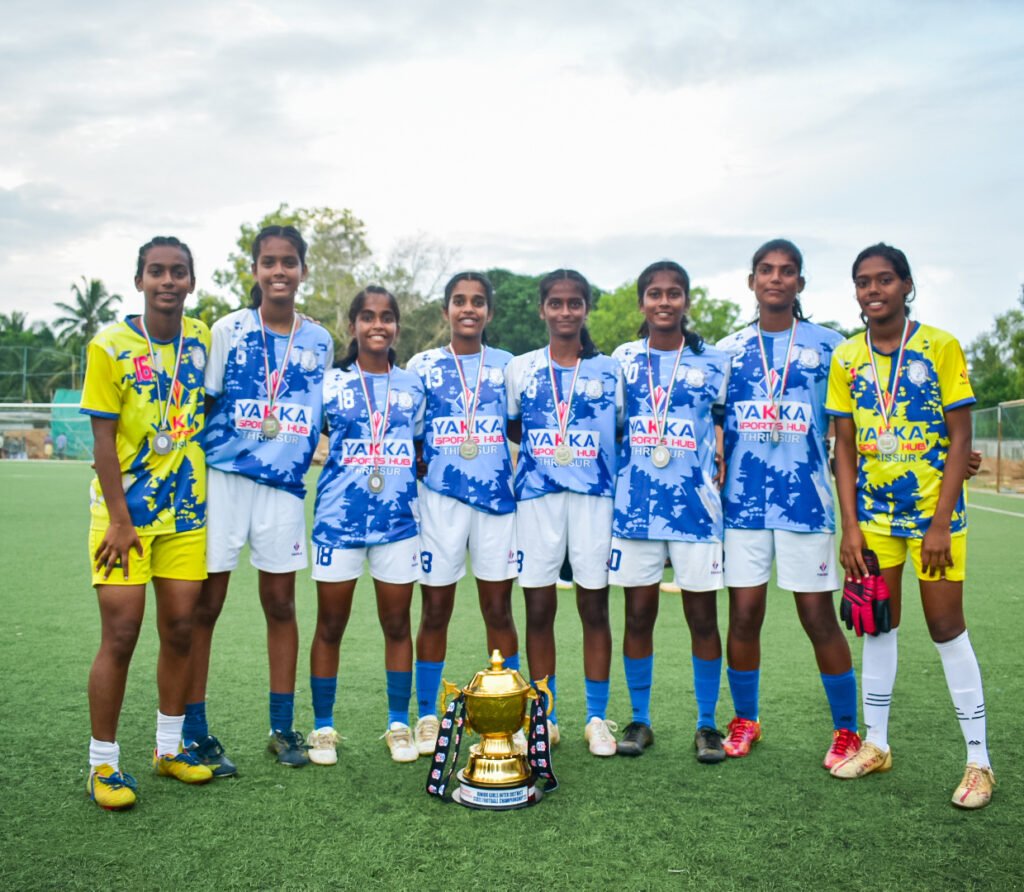
The Rise of ISV KERALA
With growing recognition and success, the academy rebranded itself as ISV Kerala, with the vision of creating a broader impact across the state. Today, it operates three training centres — at Sacred Heart College, Chalakudy, where senior players receive advanced training, and at SNVHSS Aloor and St. Antony’s Kottat, where grassroots and junior development programs are conducted. Across these centres, the academy now serves 107 girls under the guidance of seven dedicated coaches.
ISV Kerala blends sports training with social development — focusing on leadership, discipline, education, and empowerment through football. Its roots in the Innuneeli Movement and Innuneeli Smaraka Vayanshala continue to shape its values.
ISV Kerala aims to become the leading girls’ football academy in India, with the vision of competing in the Indian Women’s League and producing international players through strong grassroots development. Above all, the academy believes football is a powerful tool to transform society and nurture individuals with values, discipline, and commitment. For girls who have long been sidelined from the playing field, football offers not only physical and mental strength but also lessons in resilience, teamwork, and hard work, helping them accept defeat gracefully and strive for success.
The past four years of ISV Kerala’s journey have proven that increasing girls’ participation in sports is one of the most effective paths to women’s empowerment. The academy remains committed to providing training to every girl who wishes to play football. More than just a training centre, ISV Kerala is a community-driven initiative powered by a public library and the collective effort of the people. The values and vision of the library naturally flow into the academy, as football becomes a platform to bring girls together, united by passion and purpose.
As the academy grows in line with its dreams and vision, it needs support from every corner of society. More girls must join this movement so that the mission of women’s empowerment through football can be fully realized. To reach its true potential, the academy requires enhanced training facilities, improved infrastructure, modern technology, advanced coaching, better nutrition, and greater match exposure. While ISV Kerala continues to work tirelessly to gather these resources, the dream remains strong — to create not only great players but also empowered women who will inspire future generations.
Today, the same collective energy that once saved a hut from erasure — preserving the memory of Innuneeli — now powers the transformative work of ISV KERALA, fuelling the dreams of future champions in women’s football and beyond.
From an abandoned shelter emerged a library, breathing new life into a forgotten space. From that library, a movement was born — a force that inspired learning, unity, and change. Through that movement, girls now rise, strong and skilled, unafraid to chase their dreams on and off the field.
This is the proud legacy of Innuneeli Smaraka Vayanasala, and the inspiring, ongoing journey of ISV Foundation.

Let's get in touch
Address
Sithara Nagar, Elinjipra P O, Chalakudy, Kerala 680721